The Ancient "Simulation Theory": Does the Yoga Vasistha Parallel The Matrix?
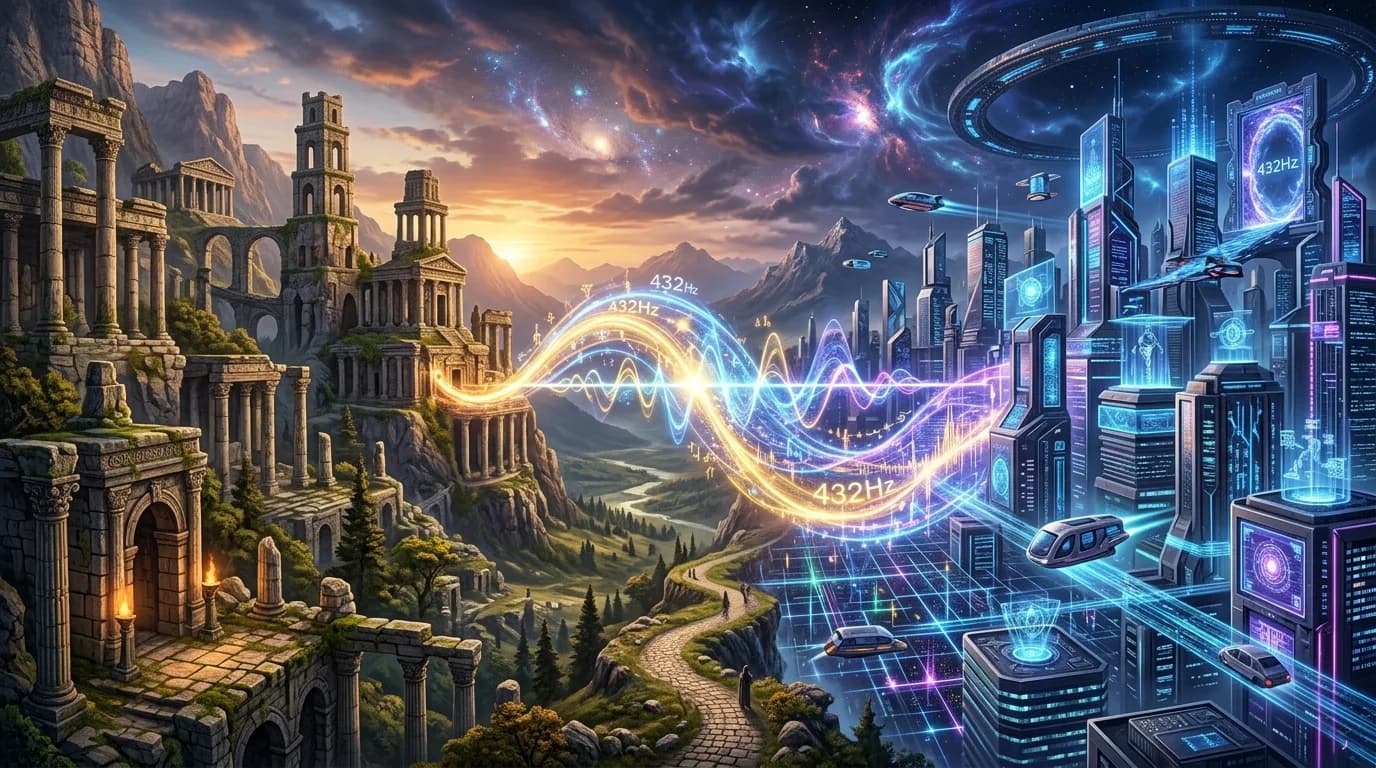
Silicon Valley billionaires are fascinated by the **Simulation Theory**—the idea that our reality might be an advanced digital construct, much like the movie *The Matrix*. But long before modern computers or sci-fi films, ancient Indian philosophy explored a strikingly similar concept.
The **Yoga Vasistha**, an ancient philosophical text featuring a dialogue between Sage Vasistha and Lord Rama, delves deep into the nature of consciousness and reality. It presents the physical world as **Maya** (illusion) or a cosmic projection. While not a technological matrix, the philosophical parallels to modern discussions about reality and quantum physics are profound.
Maya: The Original Simulation In the Yoga Vasistha, the universe is described not as a fixed physical structure, but as a projection of the cosmic mind. This concept of *Maya* suggests that what we perceive as solid reality is akin to a dream. It is not a trap, but a divine play (*Lila*), experienced by consciousness.
Queen Leela and the Relativity of Time One of the most fascinating stories in the *Utpatti Prakarana* (Chapter on Creation) of the Yoga Vasistha is that of Queen Leela.
After the death of her husband, King Padma, Goddess Saraswati takes Queen Leela on a journey across dimensions. In one parallel reality, Leela lives an entire lifetime—70 years of growing old, having a family, and ruling an empire. However, when she returns to her original world, she discovers that only **eight minutes** have passed.
The Science Connection: Time Dilation? Modern readers often compare this story to the concept of **Time Dilation** in Einstein’s Theory of Relativity (famously depicted in the movie *Interstellar*). * **The Text:** The Yoga Vasistha uses this story to illustrate the subjective, mind-dependent nature of time. * **The Science:** Physics shows that time is relative and affected by gravity and velocity.
While the ancient sages were not writing mathematical equations about gravity without telescopes, their profound philosophical insight into the fluidity of time strongly **resonates** with modern scientific concepts.
Quantum Mechanics and the "Observer Effect" Can looking at something change its reality? The famous **Double Slit Experiment** in quantum mechanics demonstrated that observing a quantum system affects its behavior. This has led to philosophical interpretations suggesting that reality at the fundamental level is undefined until interacted with or "observed."
The Yoga Vasistha states: *"This world is nothing but the objectification of the mind."*
This ancient idea shares a poetic resonance with interpretations of quantum physics. What some modern thinkers compare to the 'Observer Effect', ancient texts describe as **Sakshi Bhav** (the witnessing consciousness). According to this philosophy, the physical world—mountains, planets, our bodies—is transient, while the witnessing soul (the Eternal Observer) is the only fundamental reality.
How to "Exit" the Matrix: The Path of Moksha If the world is a simulation or an illusion, how do we get out? The ancient answer is not a spaceship or a red pill, but **Moksha** (liberation).
* **Moksha is not a physical destination after death.** It is an awakening in the present moment. * It is achieved through deep meditation, self-realization, and detachment. * It is the profound realization that you are not just a character in the cosmic play, but the very consciousness illuminating the projection.
Realizing this concept—*Aham Brahmasmi* (I am the universe/consciousness)—is said to dissolve fear and bring infinite peace, as the eternal observer cannot be harmed by the passing illusion.
***
*This reflects what the text itself says; the modern-science comparisons above are interpretation, not an established finding.*